Introduction
Two of the most common questions we receive from people living in or visiting Japan who are considering mole removal are: “Can I use Japanese public health insurance?” and “How much will it cost?” This article uses IC Clinic Tokyo as an example to explain the conditions under which insurance may apply, an estimate of costs with a 30% patient co-payment, self-pay options when insurance does not apply, and the general flow of your visit.
Here is a summary upfront.
- If your mole causes functional symptoms—such as obstructing your vision, catching on a razor or clothing, or bleeding when washing your face—or if there is a need to examine the possibility of malignancy, a physician may determine during the consultation that surgical removal under insurance coverage is appropriate.
- If the sole purpose is cosmetic improvement of appearance, insurance cannot be applied and treatment will be self-pay.
- For insurance-covered treatment, the patient co-payment percentage varies by age and income; for working-age adults it is generally 30%. With a 30% co-payment, the estimated surgical fee is approximately ¥5,000–¥14,000 for exposed areas (face, neck, hands, etc.) and approximately ¥4,000–¥13,000 for non-exposed areas (trunk, upper arm, thigh, etc.). Additional charges for consultation, tests, and other fees apply. All prices include tax.
- Patients who are not enrolled in Japanese public health insurance may receive treatment by paying the full amount out of pocket.
Whether Insurance Applies Depends on Whether There Are Symptoms
Japan’s public health insurance system is designed to cover treatment for illness and injury. For moles, a physician will assess during the consultation whether there are symptoms that require treatment; if so, surgical removal under insurance coverage may be performed.
The following are examples of cases listed on IC Clinic Tokyo’s mole page as potentially eligible for insurance coverage.
- A mole on the eyelid that obstructs vision
- A mole that catches on a razor when shaving
- A mole that catches on clothing when dressing or undressing
- A mole that bleeds when a fingernail catches it during face washing
- A mole that has been growing or is asymmetrical in shape, where the possibility of malignancy needs to be assessed
On the other hand, if none of the above symptoms are present and the only goal is to improve appearance, the treatment is considered purely cosmetic and insurance cannot be applied; it will be treated as self-pay.
Which category applies is determined by the physician who examines your mole. Please understand that the question “Can I have it removed under insurance?” cannot be answered before the consultation. Please also note that insurance-covered surgery is generally limited to one site per visit. If you wish to have multiple moles removed at the same time, self-pay CO2 laser treatment may allow multiple sites to be treated in a single session.
Estimated Costs for Insurance-Covered Treatment
Patient co-payment percentage: Varies by age and income; for working-age adults it is generally 30% of the medical fee.
Estimated surgical fee (with 30% co-payment, tax included)
- Exposed areas (face, neck, hands, etc.): approximately ¥5,000–¥14,000
- Non-exposed areas (trunk, upper arm, thigh, etc.): approximately ¥4,000–¥13,000
Costs vary within the above ranges depending on the location and size of the mole, with non-exposed areas generally being less expensive than exposed areas. In addition to the surgical fee, there will be separate charges of approximately ¥1,000 for consultation and prescription fees, approximately ¥1,000 for examination fees, and approximately ¥3,000 for pathological examination fees. Because malignant tumors may occasionally arise from moles, excised moles are in principle sent for pathological examination based on the physician’s judgment.
If you are not enrolled in Japanese public health insurance: Patients on short-term stays and others in this situation will be responsible for the full amount (100%) based on the same medical fee schedule. A cost estimate will be provided after the consultation and before surgery. For reimbursement claims to overseas travel insurance, we can issue a receipt and an English-language medical certificate (¥5,500 per document, tax included, sent by post).
Payment methods: Insurance-covered treatment must be paid in cash (Japanese yen). Credit cards may be accepted for self-pay treatment. Electronic money and QR code payments are not available.
Options When Insurance Does Not Apply: Self-Pay CO2 Laser Treatment
For patients who wish to have moles removed for cosmetic purposes, IC Clinic Tokyo offers self-pay treatment using a CO2 (carbon dioxide) laser or high-frequency scalpel.
- Treatment overview: After local anesthesia is administered, the mole tissue is vaporized and removed using a laser. Depending on the physician’s assessment, multiple sites may be treated in a single session.
- Cost (tax included). Because this is self-pay treatment, public health insurance cannot be applied.
- Main risks and side effects: Temporary redness or post-inflammatory hyperpigmentation may occur after treatment. Depending on the size and depth of the mole, there is a possibility of recurrence or minor scarring.
- Number of sessions: In many cases, treatment is completed in a single session; however, additional treatment may be required depending on the size and depth of the mole.
Insurance-covered treatment and self-pay treatment cannot be combined on the same day. Which type of treatment to pursue will be decided in consultation with the physician at the time of your appointment.
From Consultation to Post-Treatment Care (IC Clinic Tokyo)
- Booking an appointment: Please book via the English reservation form at https://ic-clinic.com/en/reservation/tokyo/. Appointments are prioritized over walk-ins.
- Reception: Patients enrolled in Japanese public health insurance will need to verify their eligibility using a My Number health insurance card or eligibility confirmation document. Please bring your residence card or passport for identity verification. A medical questionnaire in English is available.
- Consultation: The physician will examine the mole for any signs of malignancy and explain whether it qualifies for insurance-covered treatment, the recommended surgical approach, and the estimated cost. Communication with staff and the physician will be conducted in English using a translation application.
- Surgery: Depending on availability and your symptoms, surgery may be possible on the same day as your consultation. After administering local anesthesia, the physician will make an incision along a natural skin crease, close the deeper layer with absorbable sutures, and close the surface with fine sutures. For smaller moles, the procedure may take as little as approximately 5 minutes; we aim to complete all procedures within approximately 20 minutes.
- Post-treatment care: The wound will be covered with ointment and a gauze dressing or bandage, and you will receive instructions on wound care. You may shower from the following day. Soaking in a bathtub is recommended after suture removal. Please avoid alcohol and strenuous exercise for 3 days, and ideally for about 1 week.
- Suture removal: A suture-removal appointment will be scheduled approximately 1–2 weeks after surgery. The specific date will be communicated at the time of surgery. Continuing to keep the wound clean, applying tape, and taking sun protection measures after suture removal can help the scar to settle more smoothly.
After mole removal, some degree of scarring will remain. Because it is not possible to eliminate scarring entirely, suturing methods and suture materials are selected with the goal of making any scar as inconspicuous as possible.
Frequently Asked Questions
Q1. Can I use health insurance just to have a mole examined to see whether it might be cancerous?
A. Yes. Consultations and examinations that a physician determines are necessary to assess the possibility of malignancy are eligible for insurance-covered treatment. Whether to proceed with removal will be discussed after the examination. Excised moles are in principle sent for pathological examination.
Q2. Can I have a mole removed even if I do not have Japanese health insurance?
A. Yes. You will be responsible for the full amount (100%) based on the same fee schedule as insurance-covered treatment. A cost estimate will be provided after the consultation and before surgery.
Q3. Can moles near the eye also be removed?
A. In many cases, yes, though this is subject to the physician’s assessment. Please discuss this at your initial consultation.
For patients from overseas
You do not need to speak Japanese to visit IC Clinic Tokyo. Our staff communicate using translation apps, and English intake and consent forms are available. How Japanese health insurance works, self-pay costs, payment methods and what to bring are summarised on For International Patients.
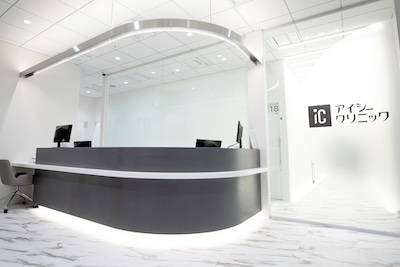
IC Clinic Tokyo — Nihonbashi Front 3F, 3-6-2 Nihonbashi, Chuo-ku, Tokyo. 3–5 min walk from JR Tokyo Station (Yaesu Exit). Hours 10:00–19:00 (closed 14:00–15:00, last reception 18:30), open Saturdays and Sundays.
Supervising physician: Kota Takakuwa, M.D., IC Clinic Tokyo