Introduction
If you are enrolled in Japan’s public health insurance system, treatments that fall under covered medical care—such as consultations, examinations, and surgery at dermatology and plastic surgery clinics—are available to you by paying only your designated out-of-pocket share at the time of service. Examples include surgery for epidermoid cysts (atheroma) and lipomas, as well as wart treatment.
However, there are three common misconceptions among foreign nationals: “having a valid residence status automatically entitles you to use health insurance,” “everyone pays 30% at the counter,” and “you only need to bring your conventional health insurance card.” This article explains the system as of 2026—covering eligibility criteria, verification at reception (My Number Card as health insurance / certificate of eligibility), out-of-pocket ratios, how covered versus non-covered treatments are determined, and what happens when eligibility cannot be confirmed—using IC Clinic Tokyo as an example.
How Is Enrollment in Japan’s Public Health Insurance Determined?
- Japan’s public health insurance system falls broadly into three categories: employee health insurance (Shakai Hoken, etc.) joined through your employer; National Health Insurance (Kokumin Kenko Hoken), enrolled through your local municipality; and the Late-Stage Elderly Medical Care System for those aged 75 and over.
- Eligibility is not determined solely by your residence status. Generally speaking, those enrolled in employee health insurance through their employer are covered under that plan, while those who are not and are registered as residents in a municipality are covered under National Health Insurance. [Note to review: general eligibility requirements for National Health Insurance, such as residency registration for those with a stay of more than three months]
- Those on short-term stays (such as tourism) are generally not enrolled in Japan’s public health insurance. In such cases, even treatments that would otherwise be covered must be paid in full out-of-pocket (100% of the insurance fee schedule).
- If you are unsure whether you are enrolled, please check with your employer’s HR or administrative department, or with the municipality where you are registered as a resident. Insurance enrollment procedures cannot be completed at the clinic.
Eligibility Verification at Reception: My Number Card as Health Insurance and the Certificate of Eligibility
- At the clinic reception, patients who have registered their My Number Card as their health insurance card (My Number health insurance card) should present that card; those who have not should present the “Certificate of Eligibility” issued by their insurer (Ministry of Health, Labour and Welfare).
- Conventional health insurance cards have not been newly issued since December 2, 2024, and their validity expired on December 1, 2025. Bringing only a conventional health insurance card will not be accepted for eligibility verification.
- The electronic certificate on a My Number Card has an expiration date. It may be used as a health insurance card for up to three months after expiry, but after that period it can no longer be used, and renewal must be completed at the municipal office where you are registered as a resident (Ministry of Health, Labour and Welfare).
- Even if your My Number health insurance card cannot be read by the reception terminal for any reason, eligibility will be confirmed through alternative means, so you will not be required to pay the full 100%—you will be able to receive covered care at your normal out-of-pocket ratio (Ministry of Health, Labour and Welfare). [Note to review: alternative verification procedures at IC Clinic Tokyo, such as the insured person eligibility declaration form]
- At our clinic, we also ask patients to present a Residence Card or passport for identity verification in addition to the eligibility check at reception.
Your Out-of-Pocket Ratio Is Determined by Age and Income
- The share you pay at the counter varies depending on your age and income. For working-age individuals (after compulsory school age through age 69), the standard rate is 30%.
- The rate differs for children below school age, those aged 70–74, and those aged 75 and over; within some age groups, the rate also varies depending on income. [Note to review: whether to list specific rates (pre-school age: 20% / ages 70–74: 20%, or 30% for those with income comparable to working-age earners / ages 75+: 10%, 20% for those above a certain income, or 30% for those with income comparable to working-age earners) or to keep it general as “varies by age and income”]
- Your out-of-pocket ratio will be confirmed during the eligibility verification process. If you are unsure of your rate, please check with your insurer.
- A High-Cost Medical Expense Benefit (Kōgaku Ryōyōhi) scheme is available, under which any out-of-pocket costs exceeding a certain monthly threshold may be reimbursed. The ceiling amount varies by income bracket. [Note to review: whether to mention the High-Cost Medical Expense Benefit; if so, to omit specific figures and direct patients to confirm with their insurer]
Whether a Treatment Is Covered by Insurance Is Determined by the Physician at Consultation
- Even if you are enrolled in health insurance, not all treatments are covered. Insurance applies only to medical care that a physician determines to be medically necessary during consultation.
- Examples in dermatology and plastic surgery:
- Surgery for epidermoid cysts (atheroma): Diagnosis, examination, surgery, and pathological testing are covered by insurance.
- Surgery for lipomas: Covered by insurance (an MRI examination is generally performed first).
- Moles and warts: Covered by insurance when the physician determines there is a medical necessity at consultation. Treatments aimed solely at cosmetic improvement are self-pay.
- Cosmetic treatments such as spot removal or miraDry: Self-pay.
- To avoid mixed billing, our clinic separates the reception process for covered care and self-pay treatments. When making a reservation, please specify whether you wish to receive covered care or self-pay treatment.
- If you undergo surgery under your health insurance coverage, you may be eligible to claim a surgical benefit from a private medical insurance policy (such as life insurance). If you require a medical certificate, please let us know at the time of your visit (medical certificates: ¥5,500 per copy, tax included; handled by post).
When Eligibility Cannot Be Confirmed / When You Are Not Enrolled in Health Insurance
- If you forget your My Number health insurance card or Certificate of Eligibility: You may still be seen. Payment will initially be collected in full (100%) at the time of your visit. If you bring proof of eligibility and your receipt within the same calendar month, we can process the adjustment at our clinic. For the following month onward, please apply for reimbursement directly to your insurer (your municipal office or health insurance union, etc.). [Note to review: whether IC Clinic Tokyo follows the same procedure as described in this site’s FAQ]
- If you are not enrolled in health insurance: Treatment will be provided on a self-pay basis, and you will be charged 100% of the insurance fee schedule for any treatment that would otherwise be covered. An estimate will be provided before treatment begins. If you intend to submit a claim to overseas travel insurance, we can issue a receipt and, if required, an English-language medical certificate.
- Payment methods: At our clinic, covered treatments must be paid in cash (Japanese yen only). Self-pay treatments may be payable by credit card in some cases. Electronic money and QR code payments are not accepted. [Note to review: accepted card brands and whether overseas-issued cards are accepted]
Approximate Costs (IC Clinic Tokyo, Covered Treatment, 30% Co-Payment, Tax Included)
All figures are estimates and may vary depending on the location, size, and scope of examination. Consultation fees, prescription fees, and examination costs are charged separately.
- Surgery for epidermoid cysts: Approximately ¥10,000–¥15,000, including consultation, examination, surgery, and pathological testing.
- Surgery for lipomas: Approximately ¥10,000–¥20,000 (MRI examination costs are payable directly to the affiliated medical facility where the scan is performed). [Note to review: where MRI costs are paid and approximate amount]
- Patients with a 10% or 20% co-payment rate will pay less than the figures above.
- Patients not enrolled in health insurance should expect to pay 100% of the insurance fee schedule for the same treatment (approximately 3.3 times the amount paid by those on a 30% co-payment). [Note to review: whether to retain the “3.3 times” reference in the English version]
FAQ
Q1. Can I use Japan’s health insurance if I have a Residence Card?
A. A Residence Card is an identity document and does not on its own entitle you to use health insurance. You may receive covered care by paying only your out-of-pocket share when you are enrolled in either employee health insurance through your employer or National Health Insurance through your municipality, and eligibility has been confirmed at reception via your My Number health insurance card or Certificate of Eligibility.
Q2. I only have a conventional health insurance card. Can I still be seen?
A. You may still be seen; however, since conventional health insurance cards expired on December 1, 2025, they can no longer be used for eligibility verification. If you do not have a My Number health insurance card, please bring the Certificate of Eligibility issued by your insurer. If you do not have it with you, you will be asked to pay the full amount at the time of your visit, after which you may either have it adjusted at our clinic within the same calendar month or apply for reimbursement directly to your insurer.
Q3. I would like to have a mole removed. Can I use insurance?
A. Insurance may apply if the physician determines there is a medical necessity at consultation. If the purpose is solely cosmetic improvement, the treatment will be self-pay. We will explain which applies after your consultation.
For patients from overseas
You do not need to speak Japanese to visit IC Clinic Tokyo. Our staff communicate using translation apps, and English intake and consent forms are available. How Japanese health insurance works, self-pay costs, payment methods and what to bring are summarised on For International Patients.
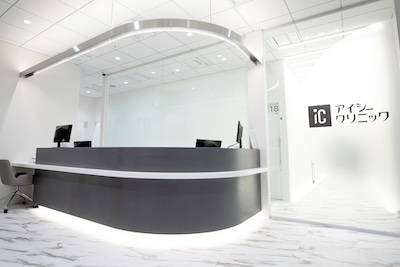
IC Clinic Tokyo — Nihonbashi Front 3F, 3-6-2 Nihonbashi, Chuo-ku, Tokyo. 3–5 min walk from JR Tokyo Station (Yaesu Exit). Hours 10:00–19:00 (closed 14:00–15:00, last reception 18:30), open Saturdays and Sundays.
Supervising physician: Kota Takakuwa, M.D., IC Clinic Tokyo